Beth Israel Hospital
Blood ShotBeth Israel Hospital serves two closely connected roles in the novel: it is where V. I. Warshawski is taken after surviving an attack at Dead Stick Pond, and later a secure setting for medical records central to the investigation of illness among workers at the Xerxes plant. The hospital’s scenes move between emergency care, an enforced period of recovery, and the interpretation of evidence that may explain years of occupational disease. In each role, it makes the consequences of bodily harm concrete while giving medical knowledge a place in the search for accountability.
Setting and Role in the Story
Beth Israel Hospital is part of Lotty Herschel’s professional world. She makes rounds there before opening her clinic, and, when V. I. Warshawski is brought to her after the attack, Lotty decides that hospital care is necessary. The hospital therefore enters the narrative not as an unfamiliar institution detached from the characters, but through a doctor who knows Warshawski and can respond to her condition directly.
The location later acquires a second function. Medical records taken from the notebooks of Dr. Chigwell are kept locked in Max Loewenthal’s safe at Beth Israel, where they cannot be casually reached by anyone moving through the city. Lotty brings a specialist’s interpretation of those records to Warshawski there. The hospital thus becomes both a place where a patient is cared for and a protected point in the chain by which medical evidence is preserved and assessed.
Emergency Treatment and Recovery
After Warshawski is found following the attack, Ron Kappelman drives her to Lotty’s clinic. Mr. Contreras insists that she should not be taken to a hospital without Lotty’s approval, and Lotty, on seeing her, summons an ambulance to take her to Beth Israel. Peppy refuses to leave her with the paramedics and holds on to one of them until the rescuers wake Warshawski long enough to make the dog let go. Warshawski remembers none of this sequence; the trip and the decisions made on her behalf reach the reader through what others later tell her.
She regains consciousness at about six on Thursday morning in a hospital bed, initially unable to understand how she got there. Trying to sit up brings back the memory of Dead Stick Pond. Her hands and wrists are bandaged, and an IV is attached to her arm. She checks that she can feel her fingertips and takes comfort in having survived and in the functioning of her hands. The passage does not turn her recovery into an uninterrupted return to strength: she falls asleep again, and the next stage is a gradual resumption of awareness and care.
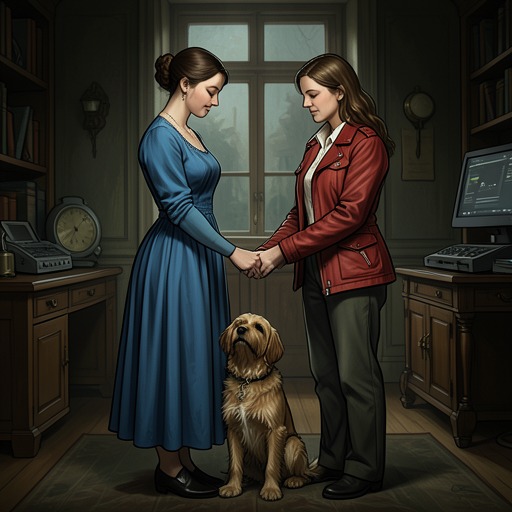
When she wakes later, the hospital routine includes vital-sign checks, doctors’ rounds, and examinations by interns. Lotty arrives while one intern is reporting his findings, listens briefly, and takes over the examination herself. She checks Warshawski’s breathing and reflexes and asks her to get out of bed and walk. Warshawski manages the tasks, but the effort leaves her panting. Lotty considers her survival and ability to walk remarkable, while still wanting her to remain in the hospital for another day rather than return to the demands of living alone.
Care, Visitors, and Physical Therapy
The hospital room also becomes a meeting place. Lieutenant Bobby Mallory visits in person; his arrival reflects angry concern as well as his closeness to Warshawski’s parents. Their exchange shows that he believes she should have stayed clear of police business, while she is frustrated at hearing his objections again. His visit places her recovery within an older network of loyalty and disagreement, rather than making the hospital a pause in the novel’s relationships.
Other visits bring both companionship and disruption. Murray Ryerson presses Warshawski for more information about what happened, but the floor supervisor reprimands her for having visitors who frighten her roommate, and Murray leaves in embarrassment. After lunch, a hospital aide takes Warshawski by wheelchair to physical therapy, where she receives wet packs, deep heat, massage, and time in a whirlpool. The return trip leaves her drowsy. Ron Kappelman is waiting in her room; he brings geraniums, acknowledges that he had failed to take her neighbor seriously, and admits that he cannot understand how Mr. Contreras persuaded him to drive all the way to the scene.
Rest remains something Warshawski needs even when her instinct is to resume action. Lotty insists that she stay another day, and the hospital’s routines and treatment make that insistence practical rather than merely protective. Warshawski is sore and impatient, and she resents being dependent on others, but the visit and physical-therapy scenes show her recovery as a process requiring time, assistance, and repeated assessment.
Medical Records and the Xerxes Investigation
Beth Israel’s investigative significance comes into focus when Lotty explains that she has consulted Dr. Christophersen, a nephrologist, about Dr. Chigwell’s notebooks. Lotty had already looked at the records herself but did not trust her own interpretation of their blood values. She leaves the notebooks secured in Max Loewenthal’s safe at the hospital and brings Warshawski photocopies summarizing the specialist’s findings. The distinction matters: the hospital safeguards the original material, while the specialist’s analysis makes its implications intelligible.
The records include blood histories for Louisa Djiak and Steve Ferraro, as well as records for approximately five hundred other employees at Humboldt Chemical’s Xerxes plant, covering 1955 to 1982. The measurements show changes consistent with kidney, liver, and bone-marrow dysfunction. In Louisa’s case, the reported values indicate noticeable kidney damage by 1967 and severe damage by 1969; her diffuse symptoms began around 1979, though she attributed them to a change of life and did not seek medical advice then. The report also notes that she came to Dr. Daniel Peters in 1984 only at her daughter’s insistence, by which time her chronic renal failure had become acute. Other complications made her a poor candidate for transplant. Ferraro’s records similarly contribute to the account of his illness and death from aplastic anemia in 1983.
These findings bear on a dispute that had already defeated a workers’ compensation suit. Xerxine, a solvent made by adding chlorine to ethylene gas, could leave toxic residues in the air during manufacture. The account of earlier plant conditions explains that exposure could affect the liver, kidneys, and central nervous system; later air scrubbers and better-sealed pipes brought concentrations down to federal standards. Humboldt Chemical had argued that illnesses might instead be attributable to smoking or the polluted air of South Chicago, and that the company had operated according to the medical knowledge available at the time. The notebooks do not simply erase those earlier obstacles: their value lies in the accumulated blood measurements, the clinical histories, and the specialist’s finding that the recorded changes are consistent with Xerxine exposure.
Narrative Significance
Beth Israel Hospital links two scales of consequence without treating them as interchangeable. Warshawski’s stay concerns one person’s survival, limited strength, and dependence on medical care and friends. The records kept and examined there concern a much larger history, tracing signs of disease across decades and hundreds of workers. By placing the evidence in the same institution where people receive treatment, the novel brings clinical interpretation close to the lives behind the statistics. The hospital is therefore not merely a backdrop to recovery: it is where the investigation gains a more substantial medical basis, and where care for an injured individual meets the attempt to establish what industrial exposure has done to many others.